
Silas Clark is an architectural designer working at a local firm in Winnipeg, Canada. He holds a Bachelor of Environmental Design in Architecture from the University of Manitoba, where he is currently pursuing a Master of Architecture.
This site serves as an interactive portfolio and digital companion, showcasing select works from his undergraduate studies.

SELECT PROJECT


PROJECT 00
ECDYSIS
The Winnipeg Public Safety Building (1966–2020), a former brutalist police headquarters, was demolished due to public disdain and spatial obsolescence. This project explores adaptive reuse of its skeletal structure just before demolition.
Through climate analysis, the design uses strategic floor cuts, a wind-blocking landscape, and a central summer cooling tower to improve environmental comfort and urban porosity. An exterior fin system wraps the concrete grid in insulation while optimizing solar gain. The repurposed building functions as a community center, recreation hub, clinic, workshop, and short-term housing, transitioning vertically from public ground levels to private residential floors to serve the Exchange District.


ISOMETRIC MATERIAL MAP
DIGITAL DRAWING


FORM CONCEPT DISCOVERY
PHYSICAL MEDIA

EXISTING STRUCUTRE AND FACADE MODEL
1:100
CONCRETE, MDF, WOOD
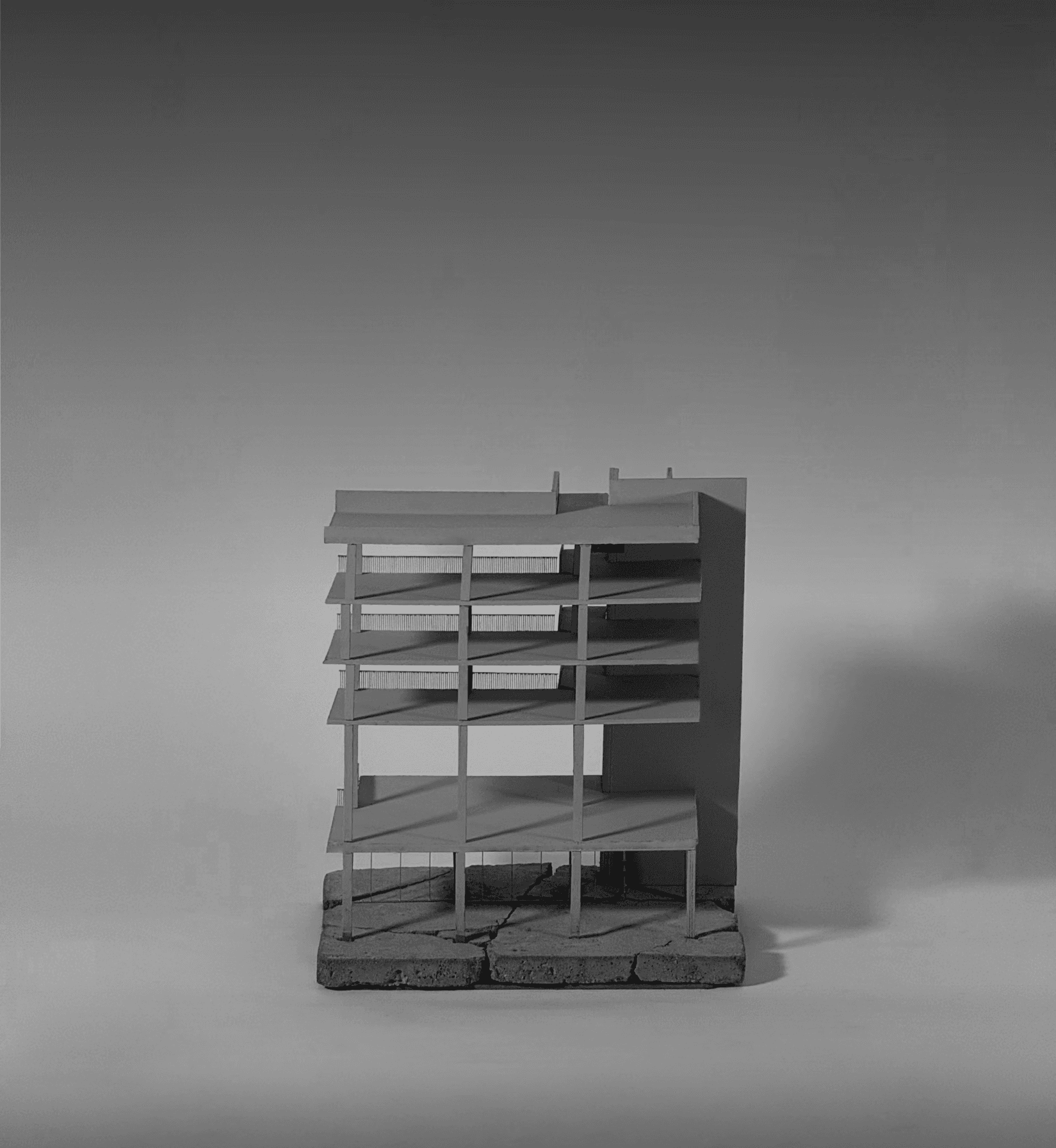
EXISTING STRUCUTRE AND FACADE MODEL
1:100
CONCRETE, MDF, WOOD


PROJECT 02
RADIANTS
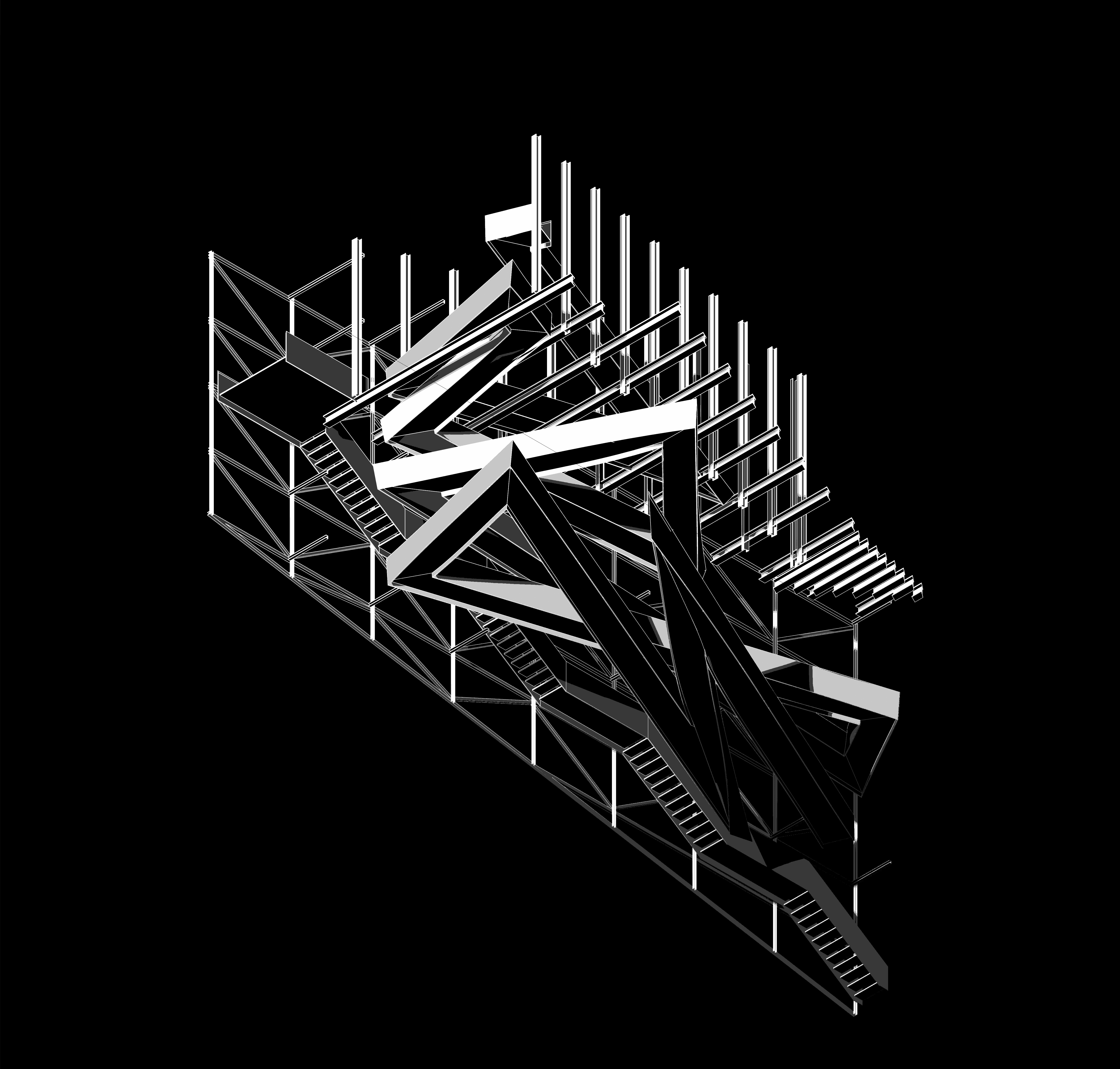
Rather than a program this projects is defined as an atrium of light and form, with a set procession above, along, and through the space. In its simplest geometries the space is created from a series of radiating planes, each positioned in accordance with viewpoints, existing site angles, and the creation of a sense of journey. These viewpoints are separated between the rising hill, sunken courtyard through the building, the internal ramps and spire, and the exterior staircase. The extreme elevation changes require engagement and awareness of the site, the interior, and the path at all times. These points are repeatedly revealed and hidden along the path, dynamically altering the perception of space and atmosphere throughout.
With the studio focus on axonometric and parallel projections, in addition to model building the project was naturally formed through a three-dimensional understanding of form and space. This led to compound angles in every element of the building, with dramatically sliced walls that taper with height.


EXPLODED AXONOMETRIC ELEMENTS
DIGITAL COMPOSTION
AFFNITY
EXPLODED AXONOMETRIC ELEMENTS
DIGITAL COMPOSTION
AFFNITY

SIDE AND FRONT SECTIONS
2D DRAWING
AFFNITY
WORMS EYE STRUCTURAL DIAGRAM
AXONOMETRIC DRAWING
AFFNITY


PROJECT 01
PRESSURES
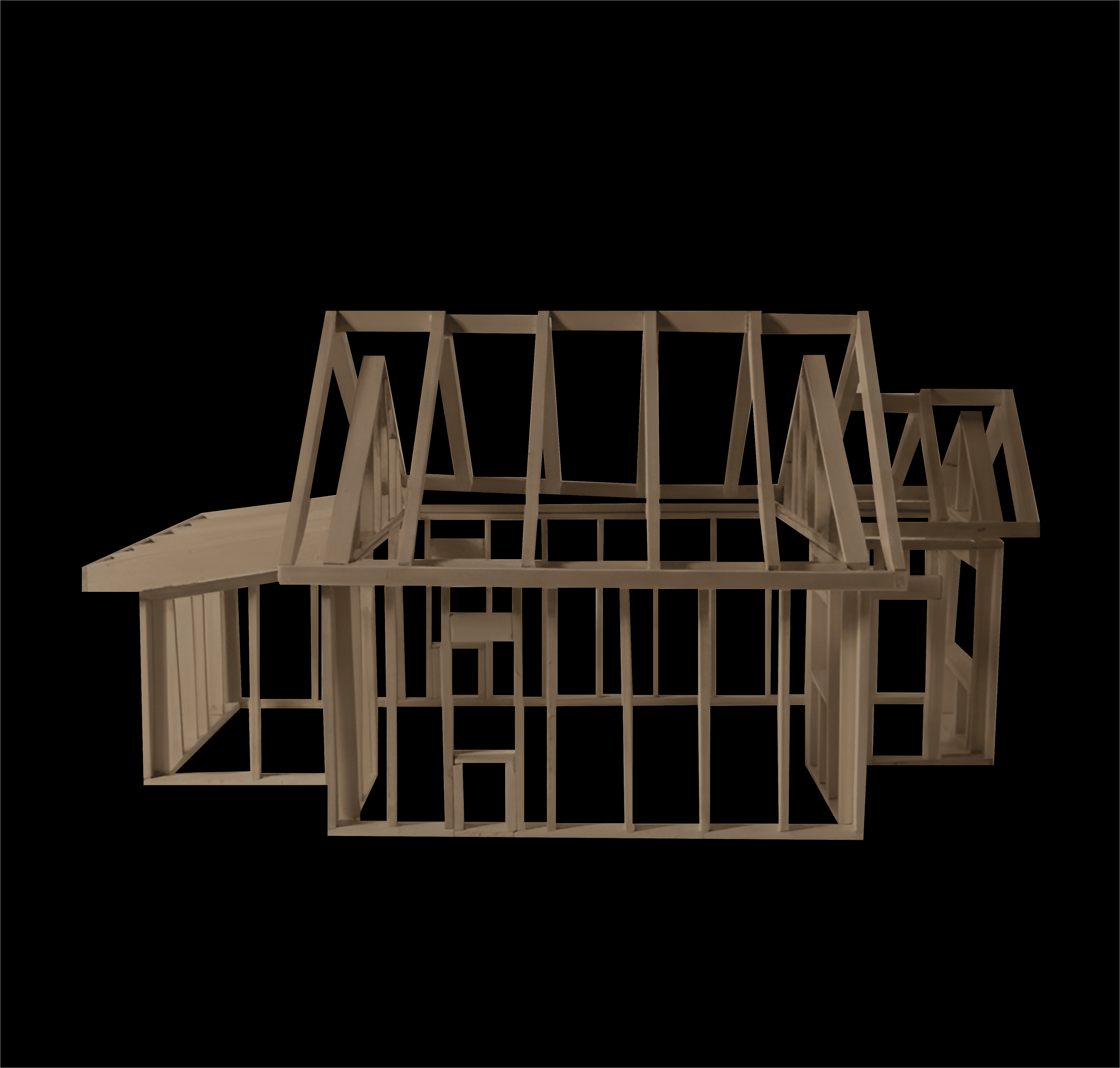
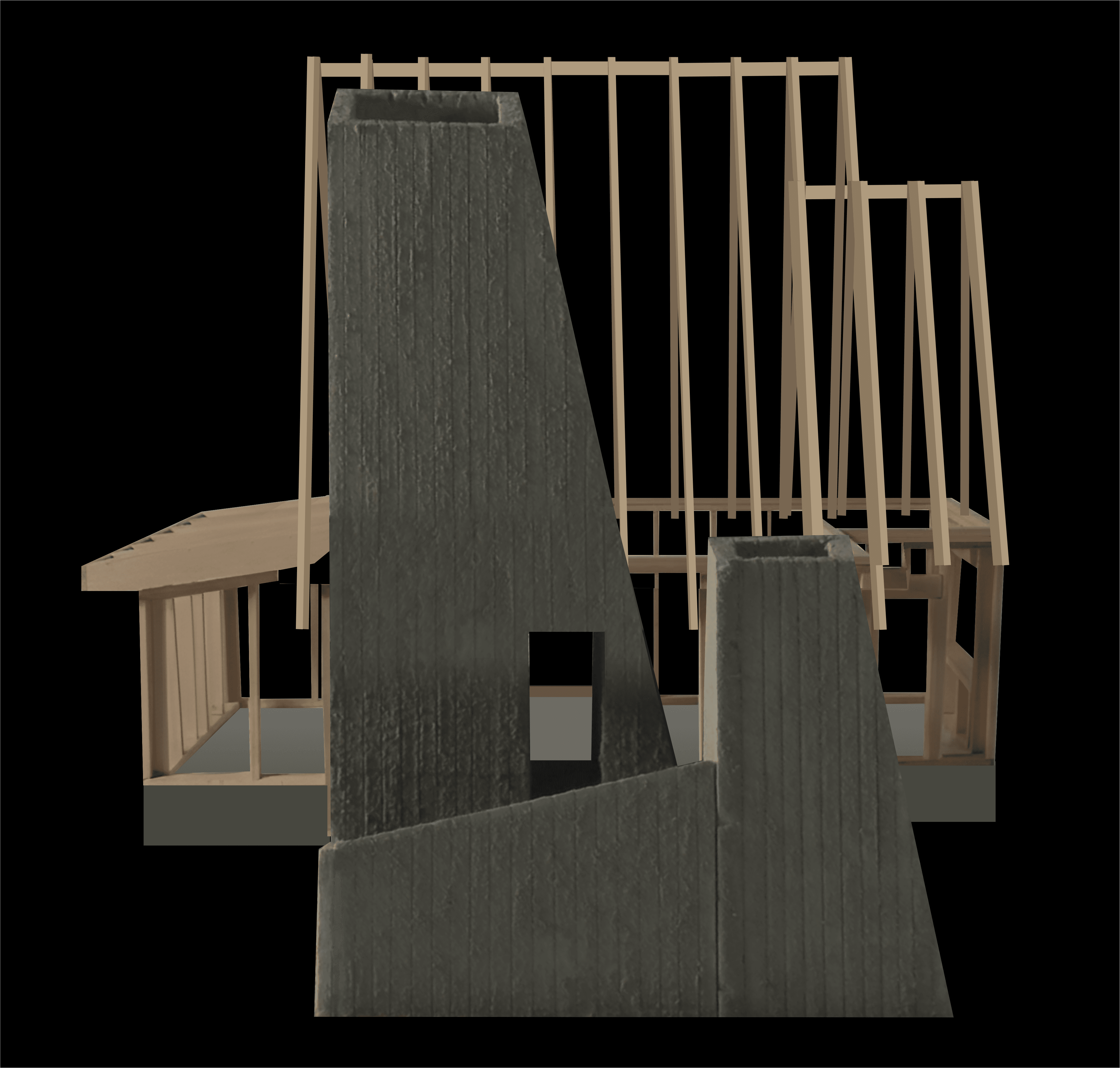
How can spaces be designed to simutaneously divide and unite its inhabitnats. This project takes a long standing 1914 home in Transcona, Winnipeg and adapts and redefines the layout and structure to create spaces of pure isolation, defined by elevation, compression, and restricted vision. The site was chosen for its notably unkempt appearance, making the exisiting home the ideal cantidate for a fictional co-living situation between two distant relatives, a retired man and a young working woman. This project srtips the existing home down to foundation and framing, and restructures it with two concrete obelisks in a mother and child compostion. These, combined with a drastically steepened roofline create a new language of verticality and seperation through elevation. Each of the obelisks houses a new isolation space allowing each resident a space of focus defined by light and ascending volume.



ORIGINAL HOUSE DRAFTS
1:50
INK ON VELLUM

ORIGINAL HOUSE DRAFTS
1:50
INK ON VELLUM

ORIGINAL HOUSE FRAMING
1:50
WOOD, XPS FOAM, PAPER

ORIGINAL HOUSE FRAMING
1:50
WOOD, XPS FOAM, PAPER


PROPOSAL IN ALTERED MODEL
1:50
CONCRETE, WOOD, ALUMINUM


PROPOSAL PLANS, SECTIONS, ISOMETRICS
DIGITAL DRAWINGS
RHINO 3D, AUTOCAD, BLENDER, AFFINITY

ATMOSPHERIC RENDERINGS
3D RENDER
RHINO 3D, BLENDER

ATMOSPHERIC RENDERINGS
3D RENDER
RHINO 3D, BLENDER


PROJECT 03
CORES
Upon entering the space the sight lines are restricted, invoking curiosity as to what is beyond. The carefully tuned angles and dimensions of the structure control what one is able to see from various points of view throughout the unit. This design also considers the path of light as it infiltrates the space. The intention of these sight lines is to create areas within that have varying degrees of privacy, and where spaces are only fully revealed once the viewer is immersed within the space. Each of these spaces orbits a central core, located immediately at the entry. This core serves as a center point for the two open public spaces, staged as a kitchen/dining combo and a living space. In tangent to these spaces are the more private sections of the unit.


Nejmark Architect
University of Manitoba